
Enrollment Links
Enrollment links let employees connect their own cards on a page Astrada hosts: creating personal and team links, what the person sees, and the limits.
For: developers
An enrollment link lets people connect their own cards on a page Astrada hosts, so you need no SDK page of your own for them. A link opens one subaccount, and every card enrolled through it joins that subaccount. Astrada switches enrollment links on per account; until then the endpoints below answer 409 with ENROLLMENT_LINKS_NOT_ENABLED.
How a link works
Your backend creates the link and hears what was enrolled:
Two kinds of link
- Personal link. One link for one employee.
- Your backend creates it with
POST /enrollment-links,kind: "cardholder"and your API client. ThecustomerReferenceIdyou send (a UUID, such as the employee it is for) is carried by every card enrolled through the link. - A personal link is used up by the first session that completes something, and allows at most 5 session starts before that.
- It expires after 7 days unless you set
expiresInHours.
- Your backend creates it with
- Team link. One link to share with a team.
- Your backend creates it with
POST /enrollment-linksandkind: "team"(14 days and 50 session starts by default,maxUsesup to 500), or Unified Enrollment SDK v2 creates it withPOST /subaccounts/{subaccountId}/team-linkwhen an admin presses Invite your team on an ending: the admin sees a link to copy. - A session that ends from Invite your team always ends with
next: "invite-team"ononSuccessand on theclosedevent: right away when enrollment links are off for the account, from Done on the link screen, or when the link can't be made.teamLink({ id, url, expiresAt }) comes with it only when a link was made. - A page with
bulkEnrollment: "forced"never offers Invite your team.
- Your backend creates it with
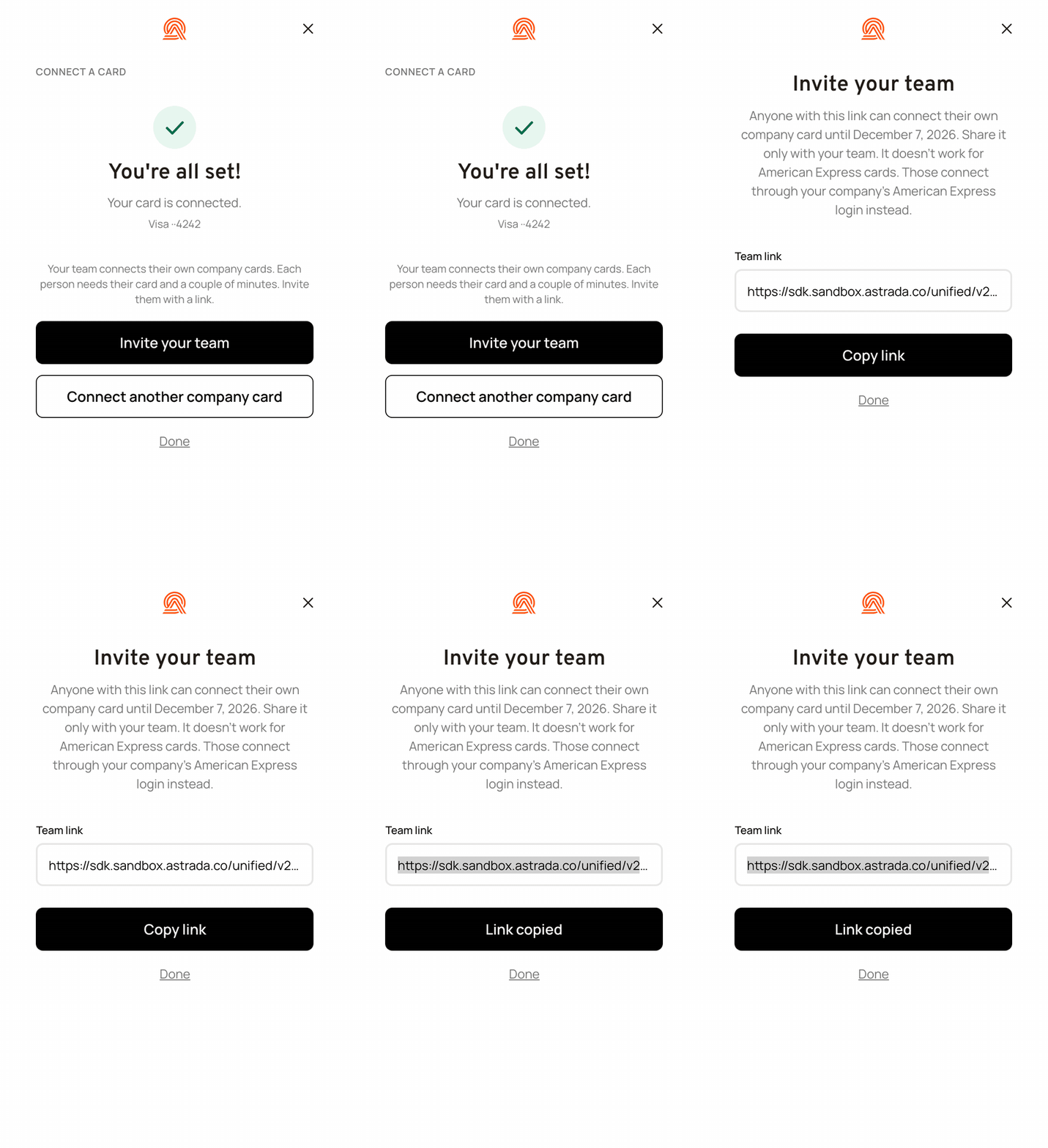
An admin makes a team link and copies it (8 s).
What the person sees
Link pages carry card enrollment only: no bulk enrollment and no bank step. A person who opens a working link goes through these screens:
- The start page. The link opens
enroll.htmlunder/unified/v2/on the SDK host (sdk.astrada.co, orsdk.sandbox.astrada.coin sandbox), with the link's secret after#. The page strips the secret from the address before it makes any request.- It names your platform (the brand profile's name, else the link's
platformName, else your account's name) and the employer (the link'sorganizationName, when you send one). Once Astrada has set a brand profile for your account, the page header shows your logo and name, with "Powered by Astrada" under them, and the page's buttons take your accent color (Your brand on the hosted page). - The consent text is Astrada's.
- It names your platform (the brand profile's name, else the link's
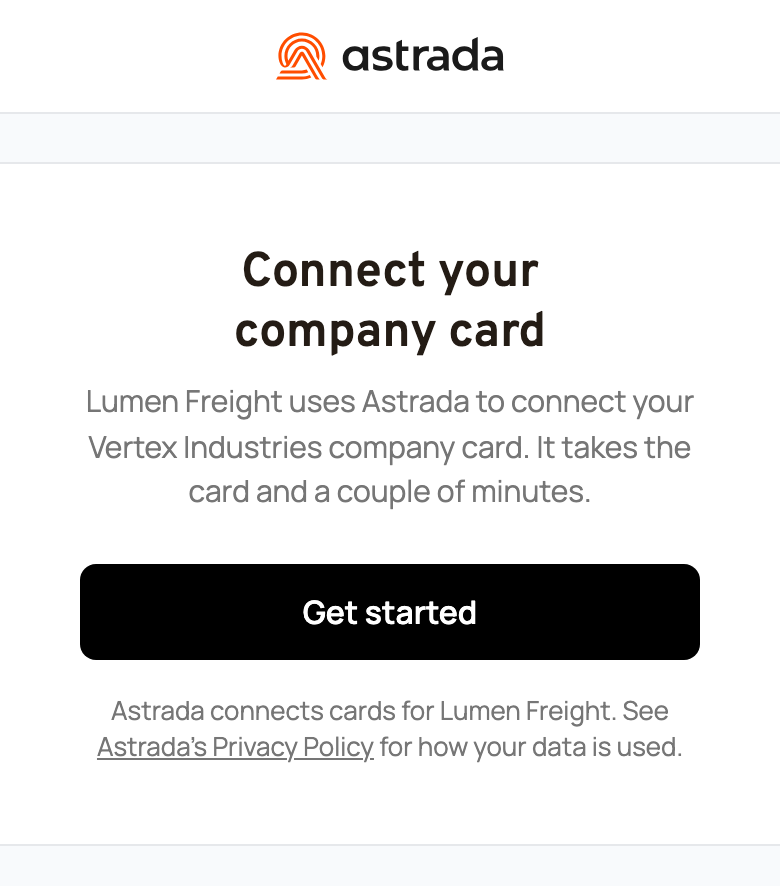
The start page a link opens. A personal link and a team link look the same here.
- Get started. The person presses Get started. A team link first asks the person to prove they're human.
- The card form. The page runs the SDK as an employee page (
persona: "cardholder") for the link's subaccount, so it opens on the card form. The card form's heading is the page's only heading. Because a link cannot pass terms, the card form shows only the network consent box.
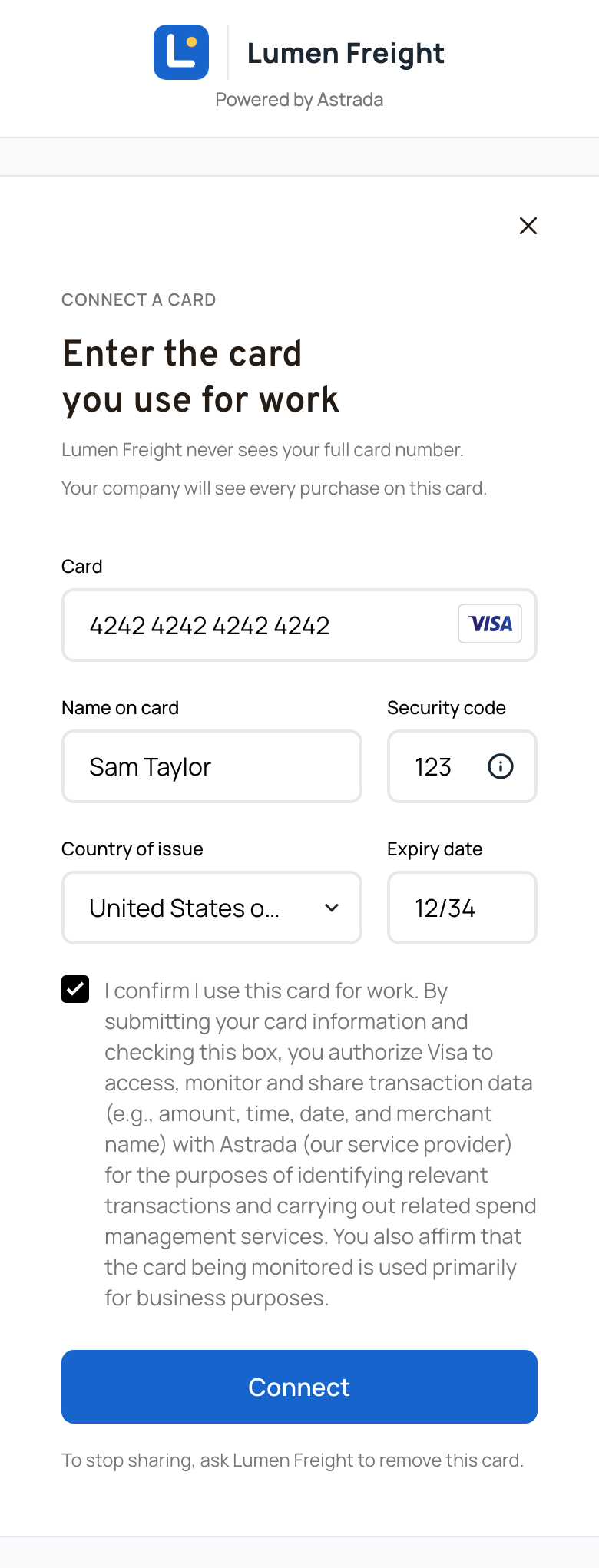
The card form on a hosted link page, with a brand profile.
- "You're done". The page's "You're done" is its one ending: the SDK's success screen closes as it opens, because a link session never offers Connect another company card and the screen has nothing but Done.
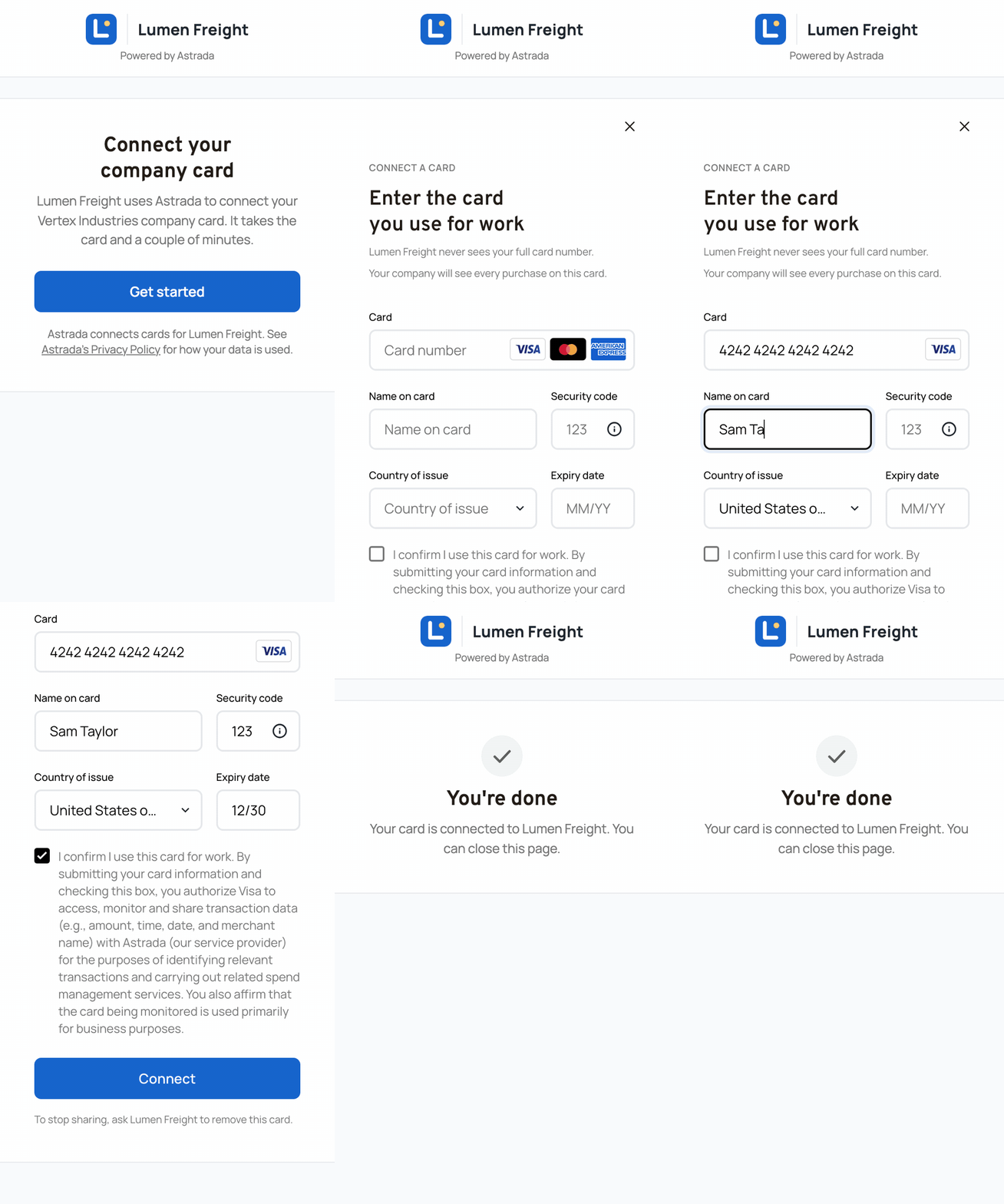
A link from start page to You're done, with a brand profile (15 s).
Your brand on the hosted page
The hosted page can show your platform's name, logo and accent color. These come from a brand profile that Astrada sets on your account. No API call sets it, and no field you send when you create a link changes the look.
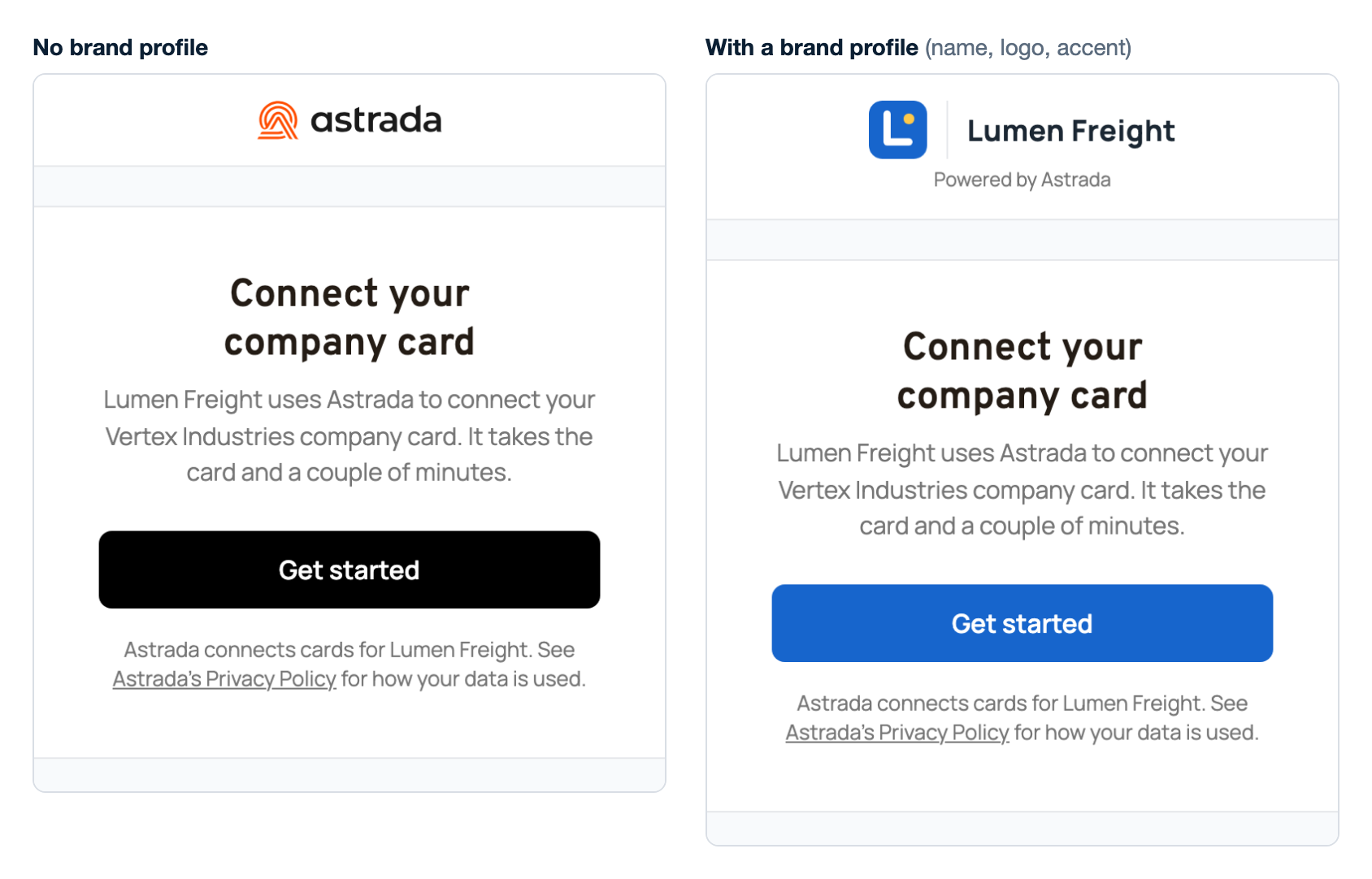
The same link without and with a brand profile.
What a brand profile holds
| Part | What it does on the page | Rules |
|---|---|---|
| Display name | Shown in the header beside the logo. Also used everywhere the page and the card form name your platform, in place of any platformName you send. | Required. 1 to 60 characters: letters, digits, spaces and . , & ' ’ ( ) - _ + ! # @, with at least one letter or digit. |
| Logo | Shown in the header, left of the name. Drawn 36 px tall and at most 160 px wide. | Optional. A PNG file, not SVG, JPEG or a link to an image. At most 512 x 512 pixels and 32 KB. Astrada removes metadata and animation from the file. |
| Accent color | Fills the page's buttons (Get started, Start again) and the card form's Connect button. The text on them stays white. | Optional. One hex color, such as #1765cc. White text on it must have a contrast ratio of at least 4.5:1, or Astrada can't set it. |
The header always keeps "Powered by Astrada" under your name.
The name is written beside the logo, so send a logo without your name in it, such as a square mark. A logo that already holds the name shows it twice.
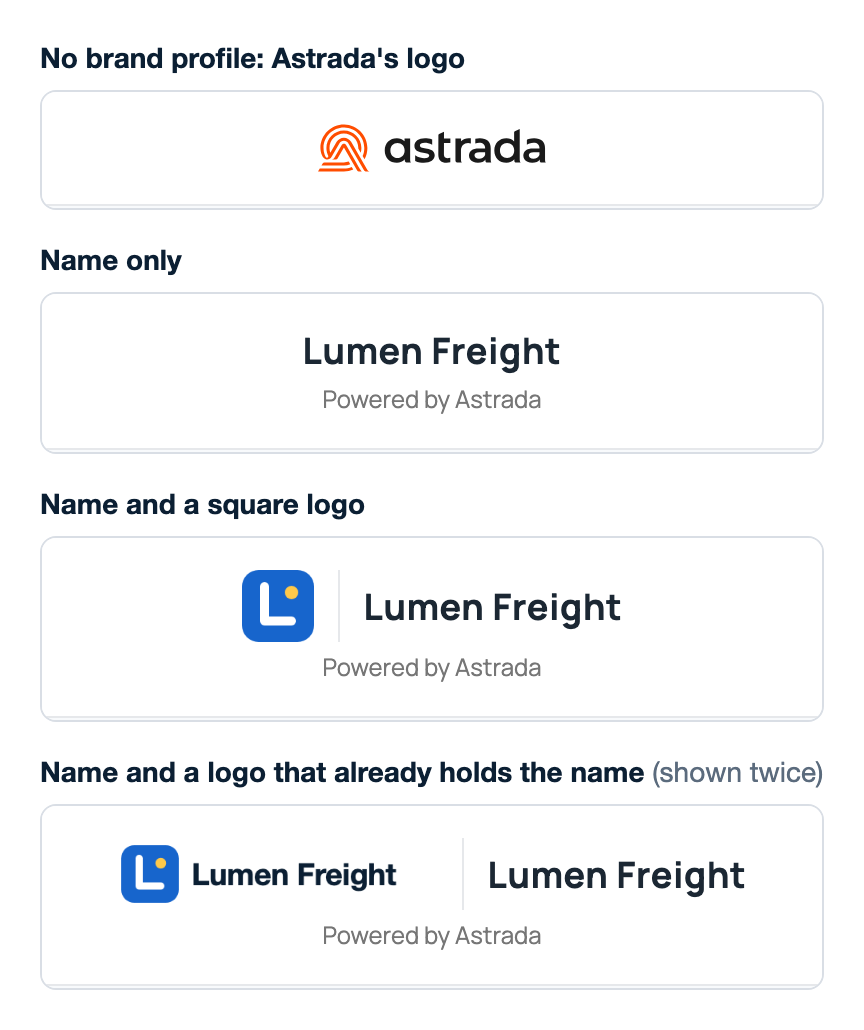
What the header shows for each kind of profile. The name is always written beside the logo.
Who sets it
Only Astrada sets a brand profile. Before setting one, Astrada checks it against the company name and domain in your contract. To set one or change it, ask your Astrada contact and send:
- the display name,
- the logo as a PNG file, if you want one,
- the accent color as a hex value, if you want one.
A change replaces the whole profile, so send every part you want to keep. Astrada can also remove the profile.
One profile covers your whole account: every subaccount and every link, including team links made from Invite your team. You can't set a different brand per subaccount or per link.
Without a brand profile
The header shows Astrada's logo and the buttons are black. The page still names your platform in its sentences. The name comes from the link's platformName, or your account's name when the link has none. The link's organizationName names the employer in the start screen's sentence and in the browser tab ("Connect your company card · Vertex Industries").
You send on POST /enrollment-links | Without a brand profile | With a brand profile |
|---|---|---|
platformName | Names your platform in the page's sentences and on the card form | Ignored on the page; the profile's display name is used |
organizationName | Names the employer on the start screen and in the tab | The same |
Where it shows
The header and the accent color stay the same from the start screen to the ending.
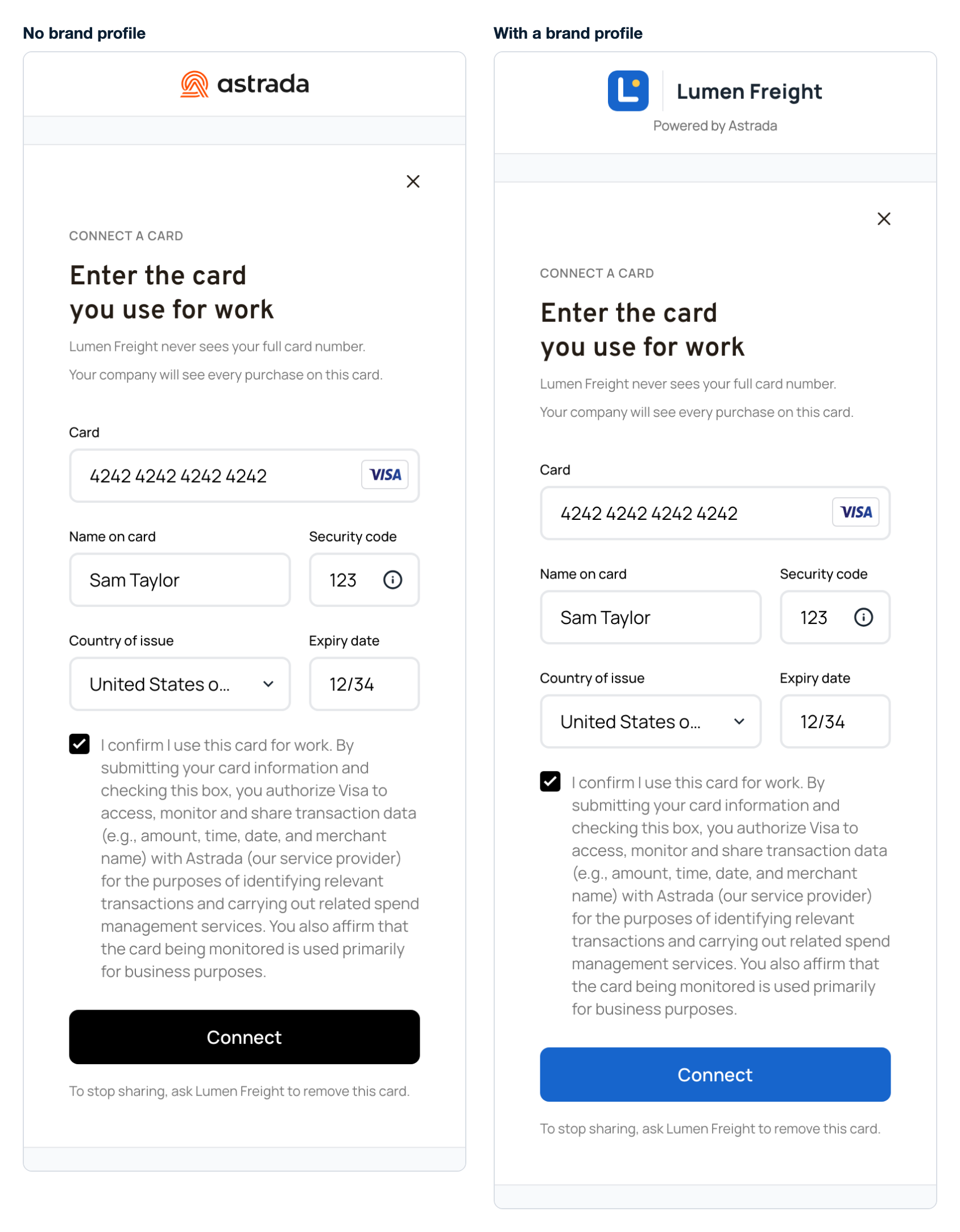
The card form without and with a brand profile.
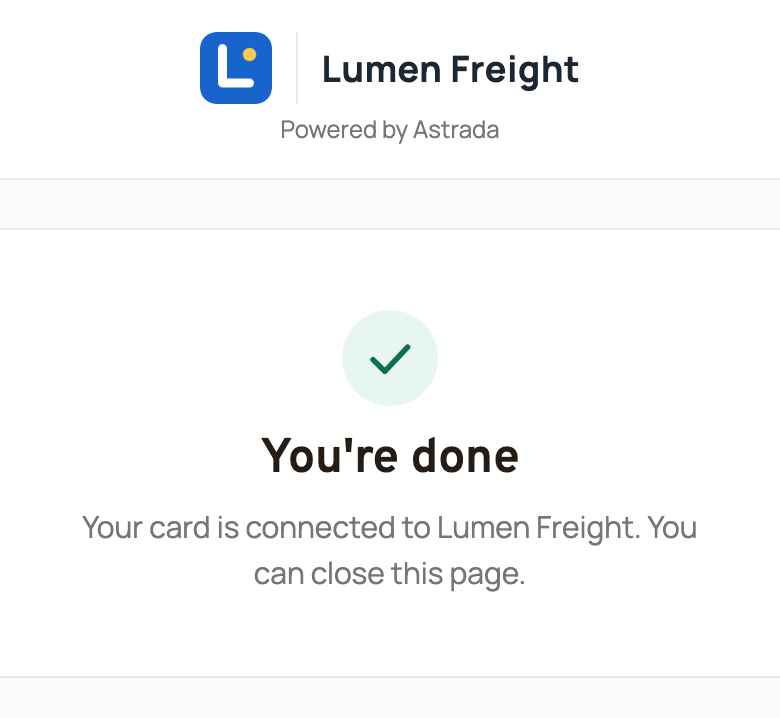
The page's one ending.
- The logo shows only in the page header. The card form itself shows no logo.
- The card form names your platform in two places: "Lumen Freight never sees your full card number" and "To stop sharing, ask Lumen Freight to remove this card".
- A link that no longer works when it is opened shows Astrada's header, even when your account has a brand profile. The page can't read your brand for a link that is expired, used up or revoked.
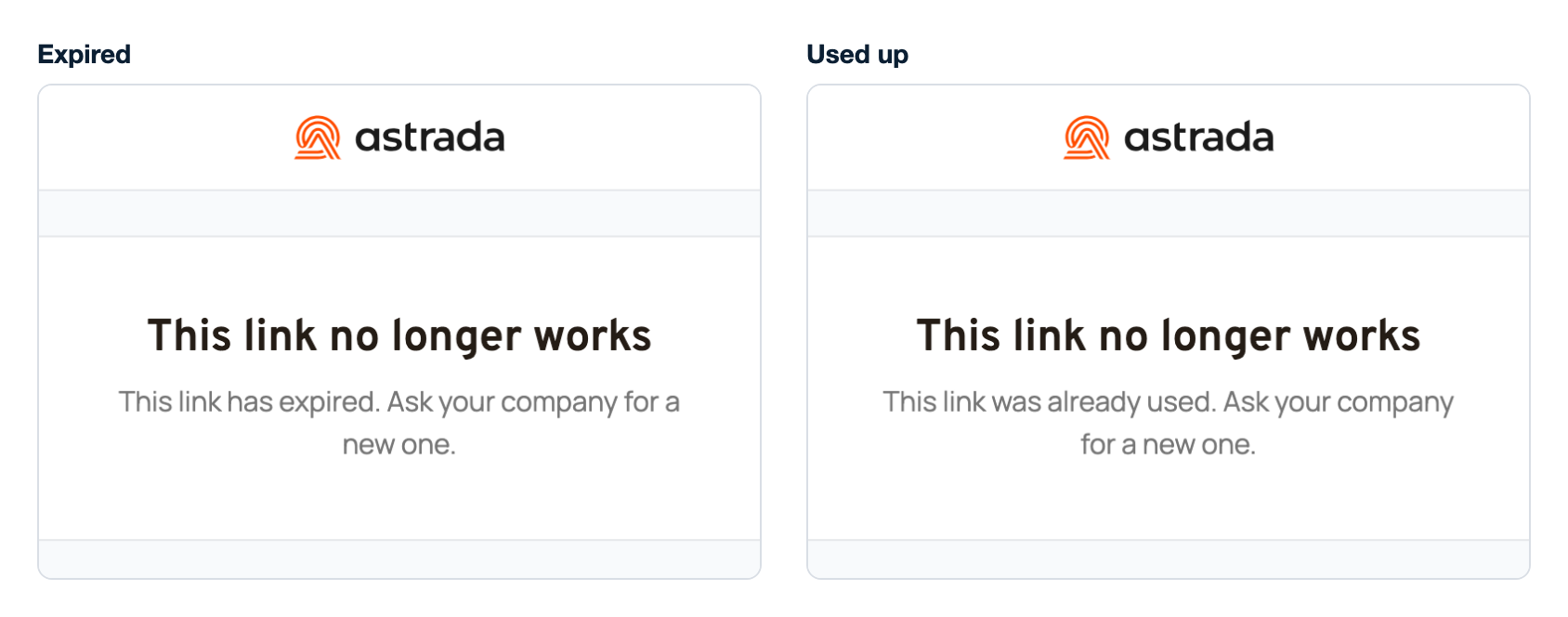
What a person sees when a link has expired or was used up. Astrada's header shows even when your account has a brand profile.
What never changes
- The words on the page, including the headings, the start screen's sentence and the messages. Only the names in them change.
- The consent text on the card form. It is Astrada's and the card network's. A link has no terms of your own, so the card form shows only the network consent box.
- "Powered by Astrada", the privacy line and its link to Astrada's Privacy Policy.
- Fonts, the page background, and every color except the accent.
- The language. The page follows the person's browser and is in English today.
How this differs from setStyle
On your own page, you style the SDK yourself: setStyle sets its colors and the logo option in open() puts your logo on the card (Visual Customization). The hosted page runs the SDK for you, so neither reaches it. There, the brand profile is the only way to change the look, and it changes only the header and the button color.
| Your own SDK page | Hosted page | |
|---|---|---|
| Who sets the look | You, in your page's code | Astrada, from your account's brand profile |
| Colors | Every variable setStyle accepts | The accent color, on the primary buttons only |
| Logo | On the card, from open() | In the page header, beside your name |
| Words | companyName, statusLabels, your terms | Fixed; only the platform and employer names change |
Before you create links
POST /enrollment-linksneedssubaccounts:write, so call it from your backend with your API client, never from a browser token.POST /subaccounts/{subaccountId}/team-linktakes the SDK token'scard-subscriptions:write, or an API client'ssubaccounts:write.- Both calls answer
409withCARD_ENROLLMENT_OFFwhen card enrollment is off on the subaccount (enrollmentPolicy.cardEnrollmentisfalse), because the hosted page has nothing else to offer. - Both calls answer
429withRATE_LIMITEDonce your account has created 2,000 links in a UTC day, team links included.POST /subaccounts/{subaccountId}/team-linkalso stops at 20 links a day for one subaccount. POST /subaccounts/{subaccountId}/team-linkmakes a new link on every call. A new link does not revoke an older one, so a link an admin already shared keeps working when they press Invite your team again. Each link ends at its own expiry, when its session starts are used up, or when it is revoked.- The response's
urlis the only place the secret is returned. Store or send it then; later reads such asGET /enrollment-links/{linkId}do not show it.POST /enrollment-links/{linkId}/revokeends a link. - A session lasts 60 minutes;
GET /enrollment-links/{linkId}lists each session with the ids the page reported. Thecardsubscriptionwebhooks stay the source of truth for what was enrolled.
When a link can't be used: Hosted enrollment link errors.
Updated about 7 hours ago