
HIGHEST Verification (Two-Hold)
Introduction
HIGHEST is the strictest verification risk tier. It proves card ownership with two factors:
- A 3DS challenge. If the issuer challenges the cardholder, that alone is sufficient and
enrollment completes. - A two-hold confirmation. If the issuer instead approves frictionlessly (no challenge), the
cardholder confirms two small temporary authorization holds on the card, read from their banking
app. Both holds are voided automatically; nothing is ever captured.
The Astrada Card Enrollment SDK renders this entire flow for you: the up-front disclosure, the place-holds prompt, and the amount-confirmation screen. You don't build any UI or write any disclosure copy. See Get the SDK to embed it.
When the second factor applies
The SDK detects which path the issuer took and shows the right screens automatically:
| Issuer's decision | What happens |
|---|---|
| Challenged the cardholder | Enrollment completes, no holds. |
| Challenge engaged, then failed | Enrollment fails, no holds (same as HIGH). |
| Approved frictionlessly (or 3DS didn't run) | The two-hold confirmation runs as the second factor. |
What the cardholder sees
These are the SDK's built-in screens. Your only setup is embedding the SDK.
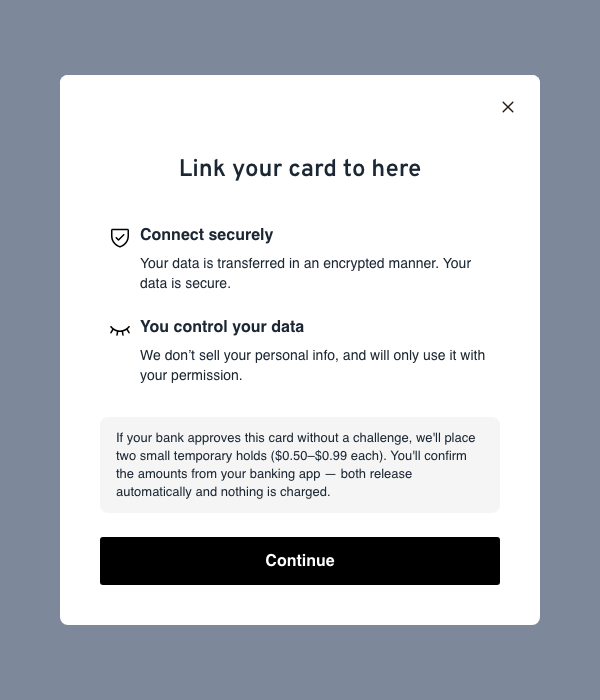
1. Up-front disclosure
Before anything is held, the SDK's intro screen tells the cardholder what to expect. This copy is built into the SDK. You don't write it:
If your bank approves this card without a challenge, we'll place two small temporary holds
($0.50–$0.99 each). You'll confirm the amounts from your banking app — both release automatically
and nothing is charged.
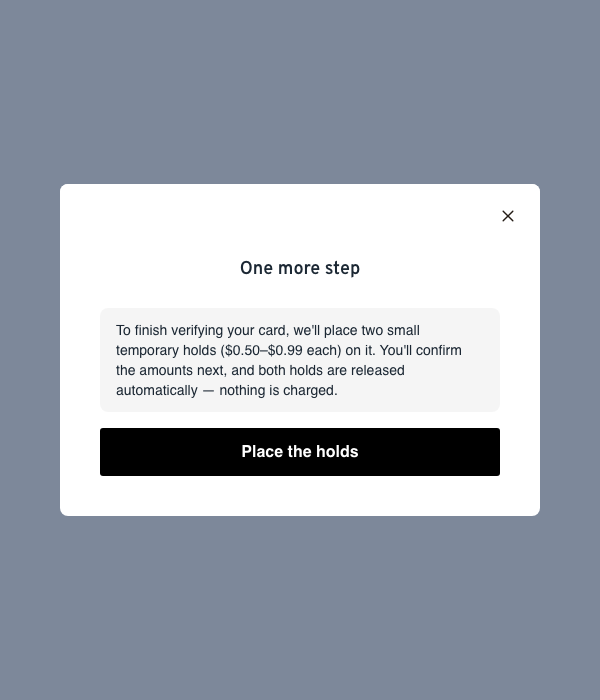
2. Place the holds
If the issuer approves frictionlessly, the SDK asks the cardholder to start the second factor. Nothing is held until they tap "Place the holds."
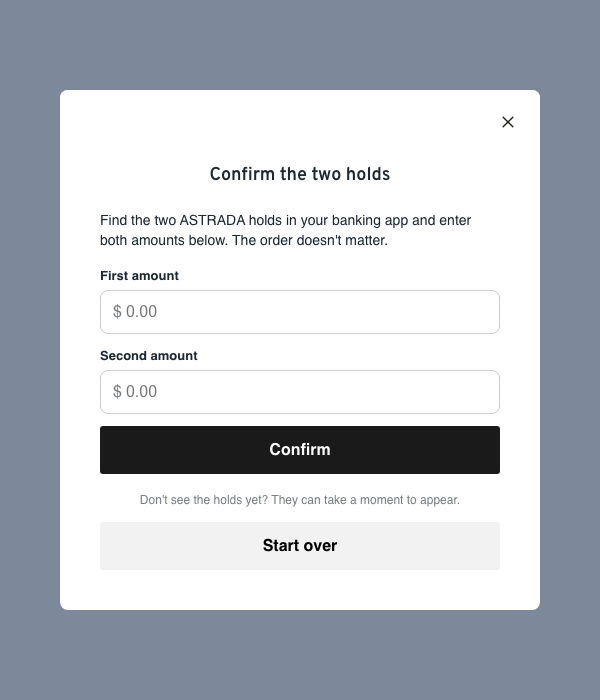
3. Confirm the two amounts
Astrada places two holds ($0.50–$0.99 each). The cardholder finds the two ASTRADA holds in their banking app and enters both amounts (the order doesn't matter). They get two attempts per set of holds.
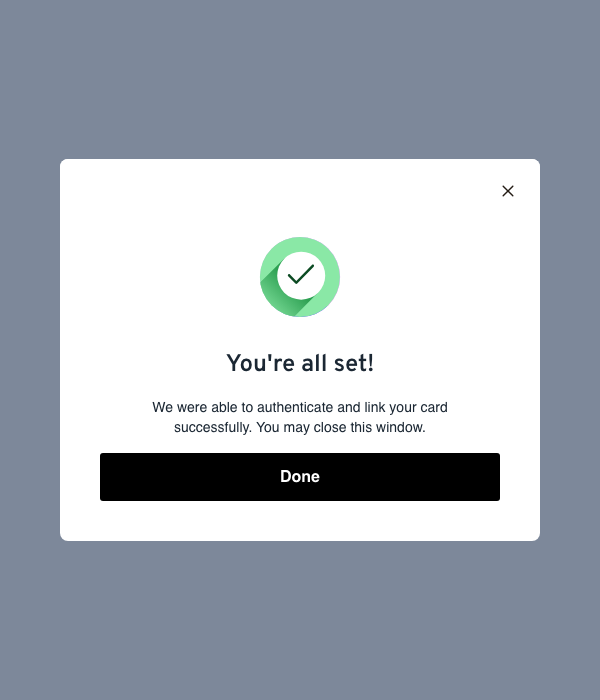
4. Done
On a match, both holds are voided and the card is linked.
The flow at a glance
sequenceDiagram
    autonumber
    participant CH as Cardholder
    participant SDK as Astrada SDK
    participant Bank as Issuer (ACS)
    CH->>SDK: Enter card (after the holds disclosure)
    SDK->>Bank: 3DS verification (HIGHEST)
    alt Issuer challenges the cardholder
        Bank-->>SDK: Challenge completed
        SDK-->>CH: Card linked (no holds)
    else Approved without a challenge
        SDK-->>CH: "Place the holds" prompt
        CH->>SDK: Taps Place the holds
        SDK->>Bank: Two temporary holds ($0.50–$0.99 each)
        SDK-->>CH: Enter the two amounts from your banking app
        CH->>SDK: Confirms both amounts
        SDK->>Bank: Void both holds
        SDK-->>CH: Card linked
    end
Retries, lockout, and expiry
- Attempts: the cardholder gets 2 tries per set of holds. A mismatch shows an inline "try
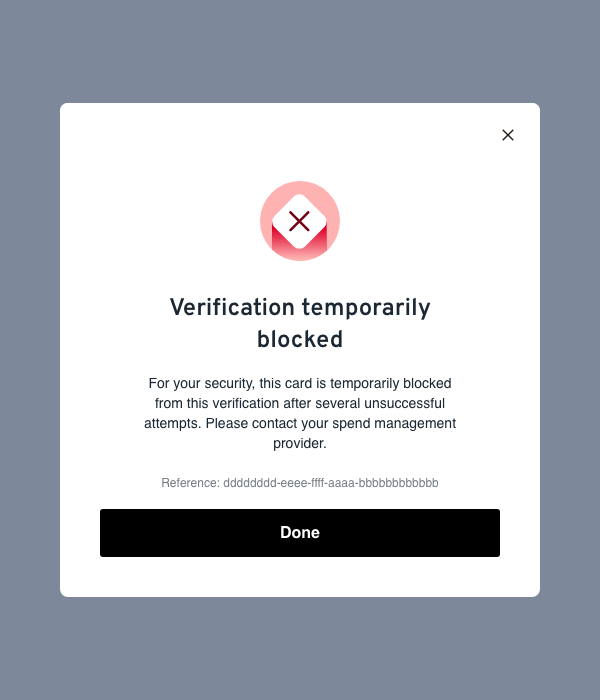
once more" message. - Lockout: after 3 failed sessions for the same card,
HIGHESTis blocked for that card
(errorCode: stripe.amount_confirm_locked) and the SDK shows a "temporarily blocked" screen. The
count isn't reset by re-enrolling. Contact Astrada to clear it. This per-card two-hold lockout is
separate from the opt-in cross-network
Verification Attempt Lockout (which you clear yourself).
- Expiry: if the cardholder doesn't confirm in time, the holds expire and the flow must be
restarted. Uncaptured holds also release on their own at the issuer.
Resuming across sessions or devices
The two-hold flow can span minutes to hours (the cardholder leaves to check their banking app). The SDK resumes automatically. If the cardholder returns to the same card, it picks up at the live step (place holds or confirm amounts) instead of starting over.
Next steps
- Verification Risk Tiers: how to set a subaccount to
HIGHEST. - Test Cards & Sandbox Testing: drive the full two-hold flow deterministically.
- Error States & Remediation: every HIGHEST failure code and screen.
- Single Card Enrollment: what the SDK does under the hood, conceptually.
Updated 3 months ago